About The Trout
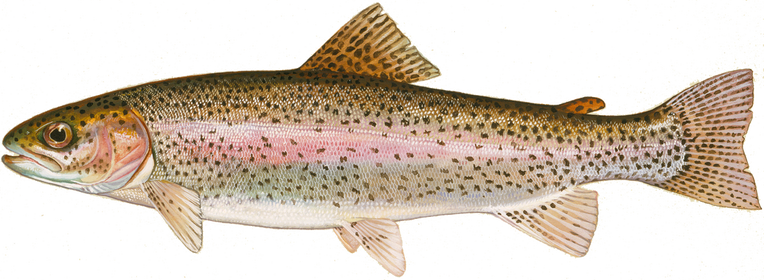
It makes sense to start at the beginning, and the first question is obviously "what is a trout?" The trout found in Missouri are members of the salmonid family, and they act similar to salmon in many ways. We have two primary species available in Missouri: the rainbow trout and the brown trout. Over the years, I've heard the occasional rumor floated about some brook trout and even a few golden trout here and there. And while there is some evidence that a few brookies have been caught in rare circumstances near historical private hatchery operations where brook trout may have been hatched at some point in the past, the "golden trout" are most certainly "palomino trout," which is essentially a yellow and white rainbow trout -- NOT a true golden trout. All Missouri trout are restricted to cold water locations where the water temperature doesn't generally move much above 75 degrees, even in the hottest part of the summer. Since the Southern half of Missouri is so rich with springs, there are numerous cold water rivers and streams that are perfect for these fish.
The Rainbow Trout is by far the most numerous trout found here. They were first introduced in Missouri's cold water streams in the 1880's. In fact, some of the earliest stockings were accomplished by railroad workers who dumped buckets of small trout into the streams the trains crossed. Some of these original strains of trout continue to exist to this day. Although there are several wild rainbow populations that can be found throughout the state, most of the decent-sized rainbow trout you'll find are hatchery-raised. Hatchery trout spend 15 months or so eating about 1-1/4 pound of trout chow to grow to stockable size.
The Rainbow Trout is by far the most numerous trout found here. They were first introduced in Missouri's cold water streams in the 1880's. In fact, some of the earliest stockings were accomplished by railroad workers who dumped buckets of small trout into the streams the trains crossed. Some of these original strains of trout continue to exist to this day. Although there are several wild rainbow populations that can be found throughout the state, most of the decent-sized rainbow trout you'll find are hatchery-raised. Hatchery trout spend 15 months or so eating about 1-1/4 pound of trout chow to grow to stockable size.
Rainbow trout, once they've lived wild for a while, will feed almost exclusively on aquatic insects (mayflies, caddis, midges, etc.), and terrestrial insects (ants, beetles, grasshopper, etc.). In some waters, the trout may feed largely on small crustaceans like scud (small freshwater shrimp) and sowbugs (aquatic "rolly pollies"). Once they reach about 17-18 inches in length, they may find it difficult to maintain their weight by bug-eating alone, and they'll start transitioning to a more pisciverous lifestyle, meaning they start hunting non-bug prey. In addition, larger rainbows will also tend toward scavenging behavior, roaming slack water picking up smelly bits of dead stuff. This gives them the great amount of protein they need to maintain their size while allowing them to conserve energy. It also offers them some protection from fisherman. Recently released hatchery fish, however, will bite on any number of items (i.e. corn, marshmallows, dough bait, etc.), mainly because they were raised on lumps of food thrown at them. After stocking, it will take a little time for them to experiment with natural food sources before they give up their preference for the hand-fed cafeteria style of feeding. It seems as though all trout, however, have some genetically imprinted desire to eat fish eggs. In virtually every trout stream, good old fashioned salmon eggs or an egg fly can work wonders when nothing else will.
After decades of trial and error, two primary strains of rainbow trout are now grown in our state-owned hatcheries and stocked in our state. These two strains are called the "Missouri Strain" and the "Missouri Arlee Strain". Yep, our state actually developed it's own strains. Cool, eh? The whole point of playing mother nature was to develop a strain of fish that grew quickly, was resistant to disease, and resilient to changing water conditions. The reason for two strains is to have a strain that will spawn in the autumn and another that will spawn in the springtime. This, of course, increases efficiency and yield from the hatcheries. All in all, they've devised a pretty neat system.
Rainbow trout, once they've lived wild for a while, will feed almost exclusively on aquatic insects (mayflies, caddis, midges, etc.), and terrestrial insects (ants, beetles, grasshopper, etc.). In some waters, the trout may feed largely on small crustaceans like scud (small freshwater shrimp) and sowbugs (aquatic "rolly pollies"). Once they reach about 17-18 inches in length, they may find it difficult to maintain their weight by bug-eating alone, and they'll start transitioning to a more pisciverous lifestyle, meaning they start hunting non-bug prey. In addition, larger rainbows will also tend toward scavenging behavior, roaming slack water picking up smelly bits of dead stuff. This gives them the great amount of protein they need to maintain their size while allowing them to conserve energy. It also offers them some protection from fisherman. Recently released hatchery fish, however, will bite on any number of items (i.e. corn, marshmallows, dough bait, etc.), mainly because they were raised on lumps of food thrown at them. After stocking, it will take a little time for them to experiment with natural food sources before they give up their preference for the hand-fed cafeteria style of feeding. It seems as though all trout, however, have some genetically imprinted desire to eat fish eggs. In virtually every trout stream, good old fashioned salmon eggs or an egg fly can work wonders when nothing else will.
After decades of trial and error, two primary strains of rainbow trout are now grown in our state-owned hatcheries and stocked in our state. These two strains are called the "Missouri Strain" and the "Missouri Arlee Strain". Yep, our state actually developed it's own strains. Cool, eh? The whole point of playing mother nature was to develop a strain of fish that grew quickly, was resistant to disease, and resilient to changing water conditions. The reason for two strains is to have a strain that will spawn in the autumn and another that will spawn in the springtime. This, of course, increases efficiency and yield from the hatcheries. All in all, they've devised a pretty neat system.
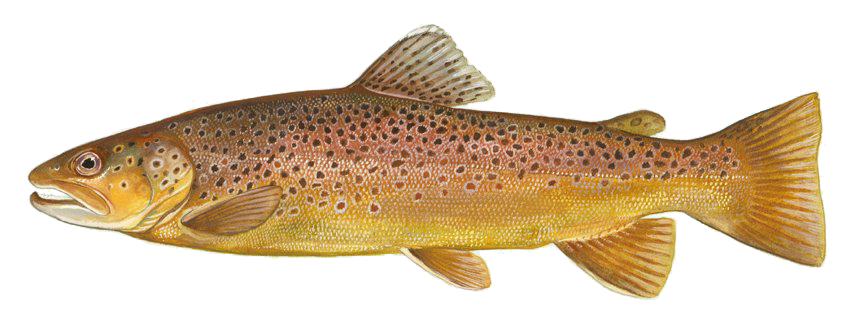
The brown trout is a different animal altogether, of course. Obviously it looks different, but it also behaves quite differently from the rainbow. These behaviors make the brownie a bit of an enigma.
The brown trout was first imported from Europe in the 1890's, according to many accounts. It was considered a good transplant for many areas, because it was able to tolerate water temperatures warmer than the smaller and slower-growing native brook trout. To this day, the brown trout is a very popular and sought-after fish. Part of the reason is that it is considered by many to be a greater challenge to catch than its rainbow cousin. There are also fewer brown trout out there. The Missouri Department of Conservation raises between 1.5 and 2 million rainbow trout per year, but rarely more than 300,000 brown trout.
The brown trout was first imported from Europe in the 1890's, according to many accounts. It was considered a good transplant for many areas, because it was able to tolerate water temperatures warmer than the smaller and slower-growing native brook trout. To this day, the brown trout is a very popular and sought-after fish. Part of the reason is that it is considered by many to be a greater challenge to catch than its rainbow cousin. There are also fewer brown trout out there. The Missouri Department of Conservation raises between 1.5 and 2 million rainbow trout per year, but rarely more than 300,000 brown trout.
Yes, the brown trout feeds and behaves differently than the rainbow, but there is no study we're aware of that supports the supposition that browns are more selective feeders. In fact, brown trout feed very much like rainbows until they reach about 12" in length and a pound in weight. Shortly thereafter, their diet begins to include more big stuff -- minnows, sculpins, crayfish, etc. -- and fewer bugs. This is simple nature. The reason? No one knows for sure, but there are a few theories which still need study. One is that they are simply more aggressive by nature. Another is that they need more protein per meal in order to meet their complex energy requirements. A third theory is more complicated, stating that browns may engage in seasonal gorging to bulk up on fat, thus allowing them to survive more dormant seasons like the coldest part of winter and the hottest part of summer. For now, at least, I'll leave the final decision to the biologists, but the result for fishermen is the same. Instead of picking at caddis larvae all day, a good-sized brownie will chase down a couple of sculpins or crayfish and be full for hours. They're not more selective -- they're just stuffed. They'll still bite, because they're opportunistic feeders, but you'll have to drift your bait to them just right. If they've recently fed, they certainly won't chase your fly or lure, unless it looks big and meaty and appears to be an exceptionally easy target.
Brown trout spawn in the fall and begin to gorge themselves prior to spawning. This pre-spawn buffet period generally begins in October and can stretch into mid-November. It is during this period that true brown trout trophy hunters come out. And since brown trout also tend to be a lot more active at night than rainbows, those trophy hunters will often try their hand casting a big streamer or small crankbait at night in search of that 30+ pound monster hiding out there somewhere. The current world record brown trout weighed a bit over 44 pounds and was caught in New Zealand, but Arkansas used to hold that record, and Missouri's Lake Taneycomo certainly has a fish or two up in that size class.