Crane Creek
Blue Ribbon Area
Only flies and artificial lures are permitted, soft plastics specifically excluded. Daily limit is 1 trout at least 18 inches long
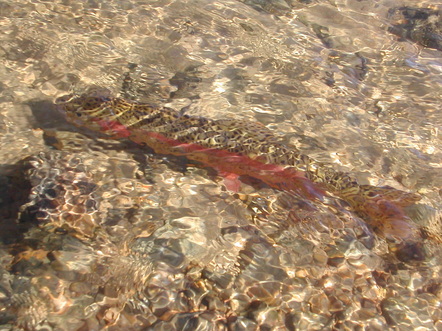 McCloud Redband spawning colors
This little creek is almost famous. It's been featured on ESPN and written up several times in various fishing magazines. And each time it is publicized, a small group of devoted local fly fishers cringe. The fear, of course, is that droves of fishermen will start crowding the banks and splashing through the creek with reckless abandon. Thus far that has not been the case. The reason? The fishing is a bit challenging for most fly fisherman who find themselves in the area. To have real success here, you should plan to spend at least a couple of full days seriously working the creek. Those just passing through and stopping for a few hours will typically struggle. Don't let me scare you off, though! Crane Creek is a unique little trout stream, and you owe it to yourself to give it some real attention.
Crane Creek is perhaps the last trout water in the world to have the pure McCloud River strain of redband rainbow trout, originally found in California's McCloud River. When I started this website (many moons ago), there were three populations, but that is no longer the case. The trout were initially stocked a century ago by railroad workers who seeded the stream with fingerlings where the tracks crossed the creek in the town of Crane. And since the creek is populated only with naturally reproduced trout, you'll catch fish of all sizes from 2 inches all the way up to full-grown adults, including some very large fish hiding in some very sheltered spots.
This creek has a good population of the "holy trinity" of caddis, mayflies and stoneflies, but most of the bugs are fairly small, so most fishermen will fish small, although larger nymphs like a hare's ear have been known to work. During the summer, black ants often produce fantastic results. Ant patterns are typically most successful when cast under and around bank-side trees, but Crane Creek is small enough to cast almost anywhere and be in the ant zone.
Crane Creek rainbows are stunning any time of the year, but they are absolutely breathtaking during spawning season. Please be careful not to wade through redds (the spawning beds) during spawning season. They look like dinner-plate sized light spots in shallow gravelly tailouts and flats.
Crane Creek is perhaps the last trout water in the world to have the pure McCloud River strain of redband rainbow trout, originally found in California's McCloud River. When I started this website (many moons ago), there were three populations, but that is no longer the case. The trout were initially stocked a century ago by railroad workers who seeded the stream with fingerlings where the tracks crossed the creek in the town of Crane. And since the creek is populated only with naturally reproduced trout, you'll catch fish of all sizes from 2 inches all the way up to full-grown adults, including some very large fish hiding in some very sheltered spots.
This creek has a good population of the "holy trinity" of caddis, mayflies and stoneflies, but most of the bugs are fairly small, so most fishermen will fish small, although larger nymphs like a hare's ear have been known to work. During the summer, black ants often produce fantastic results. Ant patterns are typically most successful when cast under and around bank-side trees, but Crane Creek is small enough to cast almost anywhere and be in the ant zone.
Crane Creek rainbows are stunning any time of the year, but they are absolutely breathtaking during spawning season. Please be careful not to wade through redds (the spawning beds) during spawning season. They look like dinner-plate sized light spots in shallow gravelly tailouts and flats.
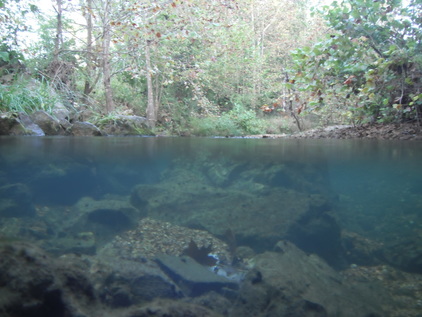
There are a couple of access points you might want to check out. The upstream section is found by taking US 60 West from Springfield for 16 or 17 miles. Turn left on Hwy 13 and travel South for about another 8 miles. When you see the left side turnoff for Hwy "A", turn right instead on a small county road. Follow that road to the left and you'll come to a parking area for the Wire Road Conservation Area, through which flows Crane Creek. If you continue on, you'll cross the creek. Keep right, you'll cross the creek a second time just downstream from a couple of springs. 30 years ago, the part of the stream that was historically the most popular with fishermen was the stretch between the Crane city park and the springs -- a bit more than 2 miles of water -- BUT, that water has gotten smaller over the years, and the best fishing in that area will be found there when the creek swells in spring and fall.
By driving into the town of Crane, you'll find that the creek flows right through the town park, and there are some highly educated trout right there. Good fishing continues downstream for some time, and over they years many enjoyed fishing near the old dairy farm area. The dairy farm has been transformed into Walnut Bend Lodge. You can check them out by clicking >HERE<.
Crane Creek is located southwest of Springfield.
By driving into the town of Crane, you'll find that the creek flows right through the town park, and there are some highly educated trout right there. Good fishing continues downstream for some time, and over they years many enjoyed fishing near the old dairy farm area. The dairy farm has been transformed into Walnut Bend Lodge. You can check them out by clicking >HERE<.
Crane Creek is located southwest of Springfield.

| crane_creek_ca_map.pdf |