Mill Creek
Blue Ribbon Area
Only flies and artificial lures are permitted, soft plastics specifically excluded. Daily limit is 1 trout at least 18 inches long
I offer guided fishing trips on this river. My ability to earn a living at this is the only reason free information like you're finding on this page exists, so help a brother out. Book a trip or help me spread the word. Thanks! Click HERE to visit my guide service page.
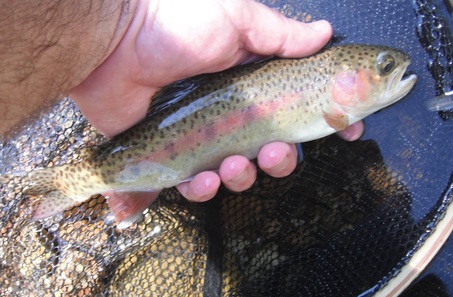
Mill Creek flows north through the Mark Twain National Forest and the Bohigian Conservation Area South of Interstate 44 between Fort Leonard Wood and Rolla. It's a lovely little creek with a very nice population of wild rainbow trout. Of course, most of the fish you'll catch will be in the 7-10" size category with a fair dosage of 4-inchers thrown in as well. But the stream regularly serves up 14" fish with the occasional whopper making an appearance here and there.
The only real trick to catching fish on this creek is dealing with the fact that it's such a small body of water. In other words, put on your ninja costume and learn how to cast around corners. If you can move quietly and make long delicate casts in tight quarters, you'll usually find a good number of opportunistically feeding fish. While traditional dry flies work well, of course, dry fly fishermen usually have a great time throwing highly visible patterns like Wulffs, Irresistables, or Humpies. And throwing big dries can be quite entertaining at times. Often smaller fish will hit these larger flies so aggressively that they'll pop straight up in the air. For a lot of reasons, the fishing here can be a wonderful experience. But…
This isn't Bennett Spring, folks. The back-casting room in the fish-holding sections is usually tight, and the fish can be quite spooky at times. But, if you can read the water, make a stealthy approach and a decent cast in fairly tight quarters, you should catch some catch fish. You'll need a long leader and a short rod (which by itself can be maddening), a general collection of decent flies, and perhaps your nerve pills.
Mill Creek flows north through the Mark Twain National Forest and the Bohigian Conservation Area South of Interstate 44 between Fort Leonard Wood and Rolla. It's a lovely little creek with a very nice population of wild rainbow trout. Of course, most of the fish you'll catch will be in the 7-10" size category with a fair dosage of 4-inchers thrown in as well. But the stream regularly serves up 14" fish with the occasional whopper making an appearance here and there.
The only real trick to catching fish on this creek is dealing with the fact that it's such a small body of water. In other words, put on your ninja costume and learn how to cast around corners. If you can move quietly and make long delicate casts in tight quarters, you'll usually find a good number of opportunistically feeding fish. While traditional dry flies work well, of course, dry fly fishermen usually have a great time throwing highly visible patterns like Wulffs, Irresistables, or Humpies. And throwing big dries can be quite entertaining at times. Often smaller fish will hit these larger flies so aggressively that they'll pop straight up in the air. For a lot of reasons, the fishing here can be a wonderful experience. But…
This isn't Bennett Spring, folks. The back-casting room in the fish-holding sections is usually tight, and the fish can be quite spooky at times. But, if you can read the water, make a stealthy approach and a decent cast in fairly tight quarters, you should catch some catch fish. You'll need a long leader and a short rod (which by itself can be maddening), a general collection of decent flies, and perhaps your nerve pills.
To find Mill Creek, take the Doolittle/Newburg exit off I-44 and head South through Doolittle and downhill into Newburg on Highway T. Follow T through town and across Little Piney Creek. Turn right on Highway P and follow it for a few miles. Watch closely for the US Forest Service sign telling you to turn left to the Mill Creek Recreation Area -- that's County Road 7550. This road will take you to an area that used to be a campground but is now only a picnic area with no camping permitted (vandals and keg parties caused this change in the rules). There is decent fishing in this area, with the trout population increasing in numbers as you move away from the easily accessible water.
If you would rather head straight to the springs, DO NOT turn left on CR 7550. Stay on P, turning left on Highway AA instead. However, you can also reach AA from the picnic area by simply continuing straight on past the picnic area on CR 7550 until you see the stop sign. Then turn left on AA. You can pull in to the Bohigian Access on AA, or continue on, turning left at the DeWitt Pond sign just before heading up a hill. Cross the slab bridge and turn left to park. You'll see a large pond, of course, which is fed by Wilkins Spring. Yelton Spring is upstream of you.
Officially, the fishing begins at Yelton Spring and extends all the way down to Little Piney Creek, but the consistent trout water realistically begins with Wilkins Spring, which dumps around 3 million gallons of water per day into DeWitt Pond, which in turn feeds the creek. Fishing upstream of the bridge is occasionally impossible, as Yelton Spring dries up at times.
If you would rather head straight to the springs, DO NOT turn left on CR 7550. Stay on P, turning left on Highway AA instead. However, you can also reach AA from the picnic area by simply continuing straight on past the picnic area on CR 7550 until you see the stop sign. Then turn left on AA. You can pull in to the Bohigian Access on AA, or continue on, turning left at the DeWitt Pond sign just before heading up a hill. Cross the slab bridge and turn left to park. You'll see a large pond, of course, which is fed by Wilkins Spring. Yelton Spring is upstream of you.
Officially, the fishing begins at Yelton Spring and extends all the way down to Little Piney Creek, but the consistent trout water realistically begins with Wilkins Spring, which dumps around 3 million gallons of water per day into DeWitt Pond, which in turn feeds the creek. Fishing upstream of the bridge is occasionally impossible, as Yelton Spring dries up at times.

| bohigian_ca_map.pdf |