Roaring River State Park Regulations
Between March 1 and October 31
The daily limit is 4 trout, with a minimum size restriction of 15 inches to keep brown trout. A daily fishing tag is required. Regulations vary by zone. Zone 1 from the headwaters to Dry Hollow Creek: no bait restrictions; Zone 2 from Dry Hollow Creek to the old dam: Flies only; Zone 3 from the old dam to the park boundary: no bait restrictions. Special note: there is a catch-and-release area within Zone 2, which includes the waters from Dry Hollow Creek to the Hwy F bridge.
Between mid-November and mid-February
Catch-and-release fly fishing is permitted from 8:00am to 4:00pm Friday through Monday. A winter season tag is required.
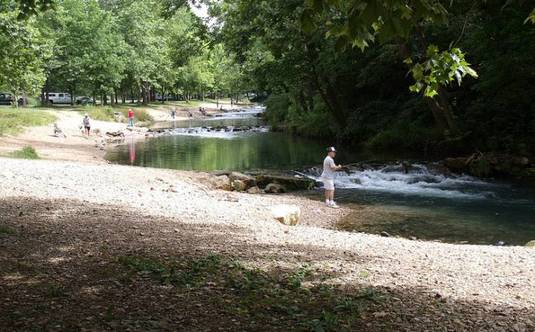 Courtesy Missouri State Parks
Roaring River State Park is in a perpetual battle with Montauk State Park for 2nd place in the "most popular trout park" contest (Bennett Spring still wins, hands down). People love the fishing, of course, but there are plenty of amenities as well. The Emory Melton Inn and Conference is what everyone seems to be talking about, but there are also the traditional rental cabins, campgrounds, a swimming pool, fly shop, and full-service restaurant. However, a big reason it's becoming more popular is that Kansas City fishermen are becoming more aware of it. Many KC trout enthusiasts have long believed that it's Bennett Spring or nothing. If you're willing to invest an extra 1/2-hour of driving time, you could be at Roaring River instead -- lighter crowds and comparable fishing.
The river is fed by a primary large spring which… well… springs from a very impressive submerged cave into a dammed spring pool full of giant fish, which we're not allowed to fish for. Perhaps they'll make it catch-and-release someday (cross your fingers). There are 3 zones with various regulations, which is typical of the three state-owned trout parks, but there are some notable differences to fishing here. First, the landscaping (or "hydro-scaping") varies quite a bit.
The river is fed by a primary large spring which… well… springs from a very impressive submerged cave into a dammed spring pool full of giant fish, which we're not allowed to fish for. Perhaps they'll make it catch-and-release someday (cross your fingers). There are 3 zones with various regulations, which is typical of the three state-owned trout parks, but there are some notable differences to fishing here. First, the landscaping (or "hydro-scaping") varies quite a bit.
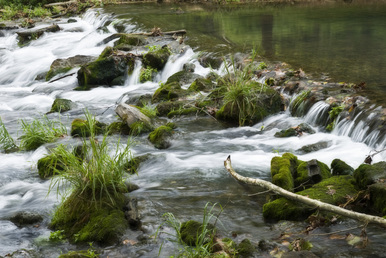
Zone 1 has been restructured with a series of natural dams, forcing the river into a series of shallow riffles and deep pools, both of which are routinely productive. The pools can be exceptional, if you can get your bait deep enough. And, a nice side effect of this restructuring is that it naturally restricts wading -- its just too deep. So what, you ask? No wading means that the aquatic insects are able to maintain a strong population and, thus, the fish eat them! So what, you ask again? This means two things. First, it means that Western-style flies work well in this area. Second, the fish grow more quickly with the abundant natural food sources.
Zone 2 has a catch-and-release area, so look for the signs. This area is stocked less frequently, if at all, but the fish are also a bit bigger and act more as nature intended. An interesting twist in this area is that waders and swimmers are also permitted to be in the area, so everyone will have to mind their manners.
Zone 3 is unique among the parks. There is very little bank access and no landscaping, meaning you'll be fishing in a wilder setting with very little company. Bait fishermen have good success drifting salmon eggs under a small bobber, while fly fishermen will enjoy using pheasant tails and hare's ears while watching for some decent little mayfly and caddis hatches to prompt them to tie on a dry. Spin fishermen will have a ball casting in-line spinners into pools and near rootwads.
Roaring River State Park is located just off Hwy 112.
Zone 2 has a catch-and-release area, so look for the signs. This area is stocked less frequently, if at all, but the fish are also a bit bigger and act more as nature intended. An interesting twist in this area is that waders and swimmers are also permitted to be in the area, so everyone will have to mind their manners.
Zone 3 is unique among the parks. There is very little bank access and no landscaping, meaning you'll be fishing in a wilder setting with very little company. Bait fishermen have good success drifting salmon eggs under a small bobber, while fly fishermen will enjoy using pheasant tails and hare's ears while watching for some decent little mayfly and caddis hatches to prompt them to tie on a dry. Spin fishermen will have a ball casting in-line spinners into pools and near rootwads.
Roaring River State Park is located just off Hwy 112.

| roaring_river_state_park_map.pdf |